
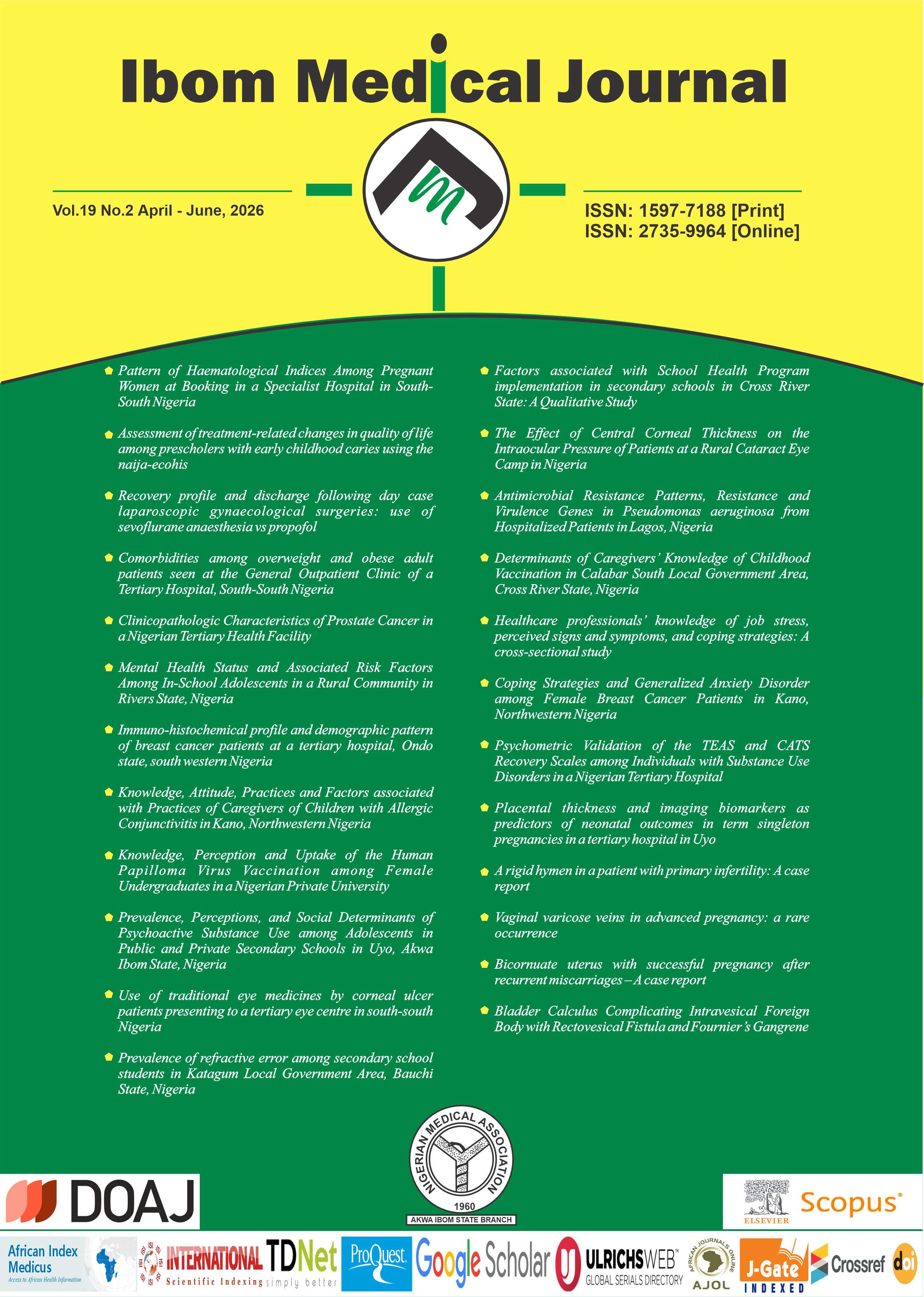
Prevalence of refractive error among secondary school students in Katagum Local Government Area, Bauchi State, Nigeria
DOI:
https://doi.org/10.61386/imj.v19i2.1068Keywords:
Refractive error, Visual impairment, Secondary school students, Prevalence, Bauchi State, NigeriaAbstract
Background: Uncorrected refractive error is the most common cause of childhood visual impairment and the second leading cause of treatable blindness. It significantly impacts overall socio-economic development and is particularly common in low- and middle-income countries.
Aim: To assess the prevalence and patterns of refractive errors among public and private secondary school students in Katagum LGA, Bauchi State.
Method: A descriptive cross-sectional study was conducted among secondary school students selected from 10 schools across 7 wards of the LGA, using a multistage random sampling method. Ocular examinations were performed according to the modified Refractive Error Study in Children (RESC) protocol, which included visual acuity assessment, pinhole testing, and subjective refraction ± cycloplegia. Data analysis was conducted with SPSS v24. Descriptive and inferential statistics were done. The level of significance was set at p<0.05.
Results: The study included 701 students, aged 12–22 years (mean 15.7 ± 1.97), with a female: male ratio of 1:1.1. The prevalence of refractive error was 11.7% (95% CI: 4.0% to 8.8%). Myopia, hypermetropia, and astigmatism accounted for 63.4%, 26.8%, and 9.8% of the errors, respectively. Females and students aged 15–16 years had the highest burden. Low-grade myopia (−0.50 to −1.75 DS), hypermetropia (+0.5 to +1.75DS); astigmatism in that order were the most common. Spectacle correction significantly improved visual acuity, with 96.9% achieving 6/6 vision after refraction.
Conclusion: This study reports a high prevalence of refractive errors among secondary school students in Katagum LGA, with low-grade myopia, hyperopia, and astigmatism being the most frequent, especially among females, it significantly improved with spectacles. Regular routine school eye screening and provision of affordable spectacles will reduce the burden of avoidable visual impairment among students.
Downloads
Published
License
Copyright (c) 2026 Attah M, Bello SU, Faridah HI, Wali AH, Dantani AM, Oyediji FJ, Batah H, Eze UA

This work is licensed under a Creative Commons Attribution 4.0 International License.